


UTSW RCT Study, Aesthetic Surgery Journal
Surgical Team: UTSW team, including:
- Dr. Jeff Kenkel
- Dr. Abby Culver
Cases: 34 patients (68 Breasts)
- Breast 1: Brijjit as Final Closure
- Breast 2: Suture
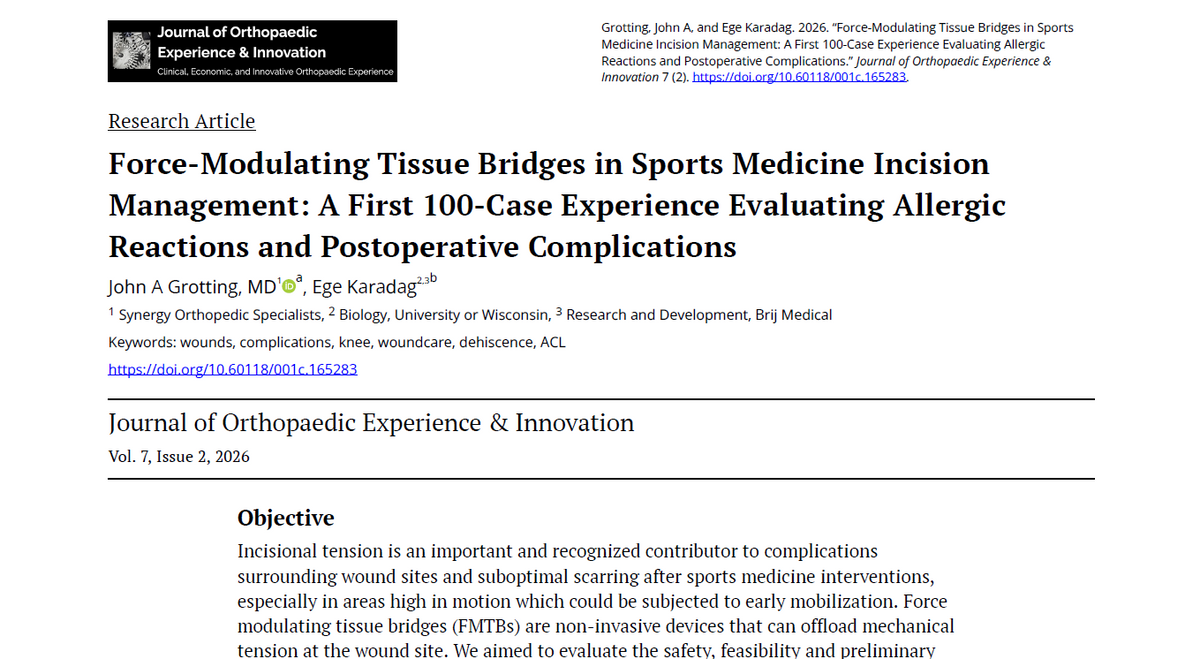
Dr. Grotting Sports Medicine Study, Journal of Orthopaedic Experience & Innovation
- Lead Surgeon: Dr. Andy Grotting
Cases: 100 consecutive outpatient sports medicine procedure

The Wall Center Study, Aesthetic Surgery Journal
- Lead Surgeon: Dr. Holly Wall
Cases: 121 patients with Brijjit (242 Breasts)
- Breast 1: Suture + Brijjit
- Breast 2: Suture

Brijjit Force Modulating Tissue Bridges Tension Study, Aesthetic Surgery Journal
- Lead Engineer: David Kazmer, PhD
- Method: Engineering Analysis
Side by Side Comparisons of Brijjit vs Suture - Speed Test
A lab tested analysis of the speed associated with using traditional sutures to close vs using the Brijjit force modulating tissue bridge.
Intended Audience & Not Medical Advice
The content on this page is intended for U.S. healthcare professionals. It is provided for scientific and educational purposes only and is not medical advice, diagnosis, or treatment. Clinical decisions should be based on each clinician’s independent medical judgment and the needs of the individual patient. Patients with questions about their care should consult a licensed healthcare professional.
Regulatory Status
BRIJ Medical's products are U.S. FDA Class I medical devices exempt from 510(k) premarket notification. FDA registration and listing do not denote FDA approval or endorsement, and no FDA approval, clearance, or endorsement is stated or implied. BRIJ Medical promotes BRIJ portfolio products only for the uses described in its current FDA-required labeling. Always read the current Instructions for Use (IFU) before use, also available at IFU – BRIJ Medical
Scientific Information Beyond Labeling
This page presents peer-reviewed publications that include scientific information not contained in the current FDA-required labeling for BRIJ products, such as comparisons with other wound closure products and outcomes in specific procedures. BRIJ products have not been approved or cleared by FDA for these uses, and the safety and effectiveness of BRIJ products for these uses have not been established. BRIJ Medical does not recommend or suggest the use of its products outside of its labeling. Findings from individual studies, centers, or patient populations may not be generalizable, and individual results vary.
Study Summaries & Disclosures
Each study summary on this page was developed by BRIJ Medical and presents the study design, sample size, endpoints, key results, adverse events, limitations, and author disclosures, including any funding or financial relationships with BRIJ Medical. Summaries are provided alongside a link to the full publication and do not replace it; the full publication should be read in its entirety.
Risk Information & Adverse Event Reporting
All medical devices carry risks. Before use, review the contraindications, warnings, and precautions in the current IFU at IFU – BRIJ Medical. To report an adverse event or product complaint, contact BRIJ Medical at feedback@brijmedical.com or +1 (877)274-5548. You may also report directly to FDA through MedWatch at www.fda.gov/medwatch or 1-800-FDA-1088.
Requests for Scientific Information
Healthcare professionals may request additional scientific or medical information about BRIJ products from BRIJ Medical's Medical Affairs at medicalaffairs@brijmedical.com.
Third-Party Publications & Links
Publications and websites linked from this page are owned and maintained by independent third parties, including journal publishers. BRIJ Medical does not control and is not responsible for their content and does not adopt any statement that is inconsistent with the FDA-required labeling. Linked content may be updated or withdrawn by its publisher without notice.
Availability Outside the U.S.
This page is intended for U.S. audiences only. Products are currently only available in the U.S. and Canada. Product availability, indications, labeling, and trade names vary by country. Visitors outside the United States should refer to the Instructions for Use for their region.
Trademarks & Intellectual Property
See our Patents page for a comprehensive list of BRIJ Medical's patents: BRIJ Medical Patents. All other product names and trademarks, including those of comparator products referenced in the publications, are the property of their respective owners. Their use does not imply any affiliation with or endorsement by those owners.